Accessibility Tools
Skip to main content
How can we help you?

Business Rates revaluation 2026

Significant changes are taking place to Business Rates from 1 April this year. We know these changes, introduced by the Government, are causing some concern for businesses, particularly in the hospitality industry.

One this page we explain what’s changing and why, as well as provide information on action you may be able to take.

What are Business Rates?

Business Rates are a form of local property tax paid by most commercial properties such as shops, pubs, warehouses, offices etc.

Although Business Rates are collected locally by councils like Wychavon, we only keep about 50% of the money. The rest of the money raised locally through Business Rates is sent back to the Government who then redistribute it as a grant to councils across the country using a complex formula based on population size, social needs and other factors to ensure the proceeds of economic growth are shared fairly across the country.

How are Business Rates calculated?

Your Business Rates bills is based on two factors:

  •  Rateable Value (RV): This is an estimate of your property’s annual rent on the open market at a specific valuation date. It is set by the Valuation Office Agency (VOA) in England and Wales, not the council.
  •      Multiplier:  This is a figure set by the Government each year and is a rate in the pound. Local councils like Wychavon take your Rateable Value and multiply it by the multiplier to calculate your bill.

For For the current financial year of 2025/26 there are two types of multiplier:

  • Small Business Multiplier for properties with a Rateable Value below £51,000: 49.9 pence in the pound
  • Standard Multiplier for properties with a Rateable Value above £51,000: 55.5 pence in the pound

What’s happening to Business Rates from 1 April 2026?

The Valuation Office Agency (VOA) regularly updates the rateable values of over 2 million commercial properties in England and Wales.

This process reflects changes in the market and is known as a revaluation. The business rates changes due to come into force from 1 April 2026 is based on valuation data from April 2024. There will then be revaluations every three years to ensure the latest data is being used to calculate bills and provide more certainty to the sector.

In the Autumn 2025 budget the Government lowered the current two multipliers to 43.2 pence and 48p respectively, and introduced two new lower multipliers specifically aimed at retail, hospitality and leisure properties.

  • ·    Small business retail, hospitality and leisure businesses with an RV under £51,000 – 38.2p
  • Standard retail, hospitality and leisure multiplier with an RV between £51,000 and £499,999 – 43p

These replace temporary annual reliefs for businesses like shops, pubs, restaurants and cinemas to provide more long-term certainty. According to the Government about 750,000 retail, leisure and hospitality businesses across the country should receive a tax cut as a result of the changes.

A new higher multiplier aimed at large distribution centres and properties used by online retailers to ensure they contribute more to the system has also been introduced:

  • Large property (all types) with an RV of £500,000 or above – 50.8p

On top of this, a 1p supplement will be applied to the relevant multiplier for 2026/27 but only to businesses not receiving Transitional Relief or Supporting Small Business Rate Relief. Money raised will support the Government’s Transitional Relief Scheme which attempts to protect businesses from large increases in bills (read on to find out more about business rates reliefs).

According to analysis of the business rate changes from real estate company Savills, the average impact of the changes for this year will be as follows:

  •  Industrial and logistics properties: will see an average increase of 21% in rateable values
  •  Office properties: will see an average rise of 6%
  •  Retail shops: will on average see a small decrease of 0.6%

In theory this is good news for many of our small businesses who may see a smaller rise than others or a slight cut in their bills. However, there is a chance your bill may still rise significantly over the next three years as a result of other factors.

Why could your business rates bill go up significantly over the next three years?

The last revaluation came into effect in 2023 but was based on data from 1 April 2021 when many sectors were still impacted by the Covid-19 pandemic. At the time retail, pubs and hospitality businesses generally saw a decrease in rateable values as these sectors were heavily impacted by lockdowns and restrictions. On top of this, temporary Covid-era financial support is also ending from this April.

This means many businesses, particularly in the hospitality sector, could now experience large rises in bills as the market readjusts following the pandemic.

Hospitality leaders also say the way rateable values are calculated does not take into account rises in costs in recent years including spikes in energy prices caused by the war in Ukraine and increasing labour costs.

The Government has put in place a transitional relief scheme to cap bills from rising too much, although many business leaders say it’s not enough.

The Government has also announced a package of business rate support specifically for pubs and live music venues that will see:

  • 2026/27 Business Rates bills cut by 15%.
  • Bills rise only by inflation (the Consumer Price Index) for 2027/28 and 2028/29.

Read more about pubs and live music venues relief on the Government's website.

Case studies

These are examples of how some businesses may be affected by the changes. Business Rates vary by individual circumstances though so these should only be treated as a guide only. Please use the Government’s Business Rates valuation checker to find out what you could be paying from 1 April 2026.

Case study 1:

A town centre café in Wychavon has been given a new rateable value of £14,000. This is about £2,500 lower than the businesses 2023 rating meaning the business now meets the criteria for small business rate relief (available to properties with an RV below £15,000).

Their initial bill for 2026/27 is £5,348. They successfully apply for small business rate relief and their bills is lowered to £3,659, compared to £4940.10 in 2025/26, meaning they will pay £1,281.10 less than last year.

Case study 2:

A rural pub in Wychavon, which is part of a large chain, has been given a rateable value of £56,000 which is £500 less than the previous valuation. With

The estimated bill is £21,227.05 with the new 15% discount for pubs applied. This is more than £10,400 less than the £31,635 the pub paid in 2025/26.

Case study 3:

A large distribution centre in Wychavon has been given a rateable value of £1,060,000 – this is £70,000 more than the previous valuation. Their estimated bill is £549,080 which is £32,930 more than the £516,150 they paid last year.

I’m worried about how I will be able to pay my Business Rates bill, what can I do?

If you are worried about the potential impact of these changes on your bill then the first thing to do is get informed.

Visit the Government’s website and type the postcode of your business into their Find a business rates valuation. Once you have your result you can click a link called ‘get an estimate of your bill’ to find out what you may be paying from April 2026. You may be surprised to find you are actually paying less or only slightly more. If you are facing a huge increase then there are other things you can do.

Check how your RV has been calculated

Sign in, or sign up, to a business rates valuation account on the Government’s website. Once logged in you can:

  • check the factual details the VOA hold about your property
  •  see how your property’s valuation was worked out
  •  let the VOA know if something is wrong with your valuation

You can also use your account to compare your property’s rateable value with similar properties in the area and check how the valuation was calculated. 

Raise a check against your current valuation

If you notice any factual errors about your property (e.g., floor area, parking, or usage) you should raise a ‘check’ case against your current 2023 valuation, which can be done within your business rates valuation account. Any factual changes will be made to your current valuation which will then influence your 2026 valuation. You can only do this up to 31 March 2026.

The Government has published guidance on setting up a business rates account online or watch this video: Business Rates Valuation Account registration 

Challenge your valuation

You cannot challenge your new valuation until after 1 April 2026. You must complete a check on the property within your business rates valuation account first before you can submit a challenge.

Challenges should be made to the Valuation Office Agency, not Wychavon.

More information on how to challenge your valuation can be found at Challenge the valuation - GOV.UK

Support available

The Government has introduced a £3.2 billion Transitional Relief scheme package to protect businesses from large rises in their bills from 1 April 2026.

You can read the Government’s Business Rates Transitional Relief factsheet to find out more.

This relief will be applied automatically to your bills by our team, so you do not need to apply.

Information about other types of Business Rates relief can also be found on the Government’s website.

Reliefs you may be eligible for include:

We will check your circumstances and apply these reliefs to your bill automatically.

Small business rates relief

Small business rate relief is available if:

  • your property’s rateable value is less than £15,000
  • your business only uses one property (you may still be able to get relief if you use more)

If your property has a rateable value of £12,000 or less, and it is the only property you use, then you will not pay business rates.

If your property has a rateable value of £12,001 to £15,000, you will get a discount that reduces gradually from 100% to zero.

When you get a second property, you’ll keep getting any existing relief on your main property for 12 months.

You can still get small business rate relief on your main property after this if both the following apply:

  • none of your other properties have a rateable value above £2,899
  • the total rateable value of all your properties is less than £20,000 (£28,000 in London)

Unlike other types of business rates relief, Small business rate relief is not automatically applied to your bills. You will need to apply to us to receive it.

How to apply for Small business rate relief

If your new rateable value from 1 April 2026 is below £15,000, you may now qualify for small business rate relief. However, you do not get this automatically and will need to apply. This means the initial bill you receive from us towards the end of March/early April 2026 may not have the relief applied and may be larger than you expected.

To apply for small business rates relief, you will need to fill in the online form on our website which will be available from 1 April 2026.

We will then check and process your claim, apply the relief and issue you with a new bill.

Other types of Business Rates reliefs are automatically applied to your bills by us as well. You do not need to apply for them. The reliefs applied to your business rates account will be listed on your bill. If you believe you qualify for a relief and it’s not listed then please contact our team.

Any questions?

If you have questions about your current bill or about Business Rates relief then please get in touch with us at This email address is being protected from spambots. You need JavaScript enabled to view it. or call 03004 560 560.

If you are struggling to pay your bill then please talk to our team as soon as possible. We have a range of payment options we can look at, as well as check you are receiving all eligible reliefs you are entitled to. The earlier you talk to us the easier it is for us to help so please don’t wait to contact us.


Changes to Retail

In this section

Changes to Retail, Hospitality and Leisure Multiplier from 1st April 2026

At the 2024 Autumn Budget, the UK Government announced that from 2026/27, existing Business Rate Relief for retail, hospitality or leisure (RHL) properties would be replaced by a lower rates multiplier to calculate the business rates payable on those properties.

The amounts of the new multipliers have been confirmed in the 2025 Autumn Budget on 26 November 2025.

Rateable values RHL Properties Non RHL Properties All Properties

Rateable value:


Below £51,000

Small Business RHL Multiplier
38.2p

Small Business Multiplier
43.2p

n/a

Rateable value:


£51,000- £499,999


Standard RHL Multiplier
43.0p

Standard Multiplier
48.0p

n/a

Rateable value:


£500,000 or more

n/a

n/a

High-value multiplier
50.8p

Small business RHL multiplier

For qualifying properties with a rateable value of under £51,000.

The multiplier will be 38.2p

Standard RHL multiplier

For qualifying properties with a rateable value between £51,000 and £499,999.

The multiplier will be 43.0p

There is no reduced multiplier for properties with a rateable value of £500,000 or higher.

Properties that will benefit from the lower multipliers

Properties that are wholly or mainly used for qualifying retail, hospitality or leisure purposes will qualify for the relief. This is a test on the use of the property, not just on the valuation description applied by the Valuation Office Agency.

Please note: Only occupied properties are entitled to the lower multipliers.

For more information visit  Business Rates Multipliers: Qualifying Retail, Hospitality or Leisure - GOV.UK

If you would like to apply for RHL please complete the form in the link below:

NDR RHL Form

Read the Budget 2025: Retail, Hospitality and Leisure Factsheet - GOV.UK


Read more …Changes to Retail

Welcome to the Evesham Business Crime Reduction Partnership

In this section

Evesham Business Crime Reduction Partnership and Wychavon logo DISC crime prevention system logo

Evesham Business Crime Reduction Partnership (EBCRP) is an initiative for the business community of Evesham to share intelligence and report incidents and Anti-social behaviour (ASB) within the daytime and night-time economies operating in the town.

With the support of the Evesham Place Board, a managing Business Crime Reduction Partnership has been established, chaired by James Carey from Waitrose & Partners , to oversee the operation of the DISC crime prevention system.

The DISC crime prevention system provides a GDPR compliant and technically secure platform for businesses to share information with each other and the police about known/persistent offenders to aid intelligence gathering and encourage the reporting of crime to improve perceptions and the ability of businesses to protect themselves. With its Desktop and App interfaces, DISC empowers local business communities to protect their property and people by ‘self-managing’ low level crime and anti- social behaviour.

More than 230 crime reduction partnerships, covering in excess of 550 towns and city centres use DISC, as well as major shopping centres, sports venues, retail multiples, security companies and the police themselves.

This scheme being facilitated by the Evesham Business Crime Reduction Partnership (EBCRP) is open to all businesses in the area and provides a number of important benefits:

  • Access to details of local offenders
  • Ability to submit Incident and Intelligence reports regarding local offenders
  • Information shared within assists the council and police better protect the business community and make better decisions around allocating of resources.
  • Evesham operates a banning scheme across all member businesses. Work together to manage the exclusion of offenders from member premises

Maximising local business member participation is essential for successful crime reduction initiatives, so DISC coms with in-built engagement tools, including an instant messaging system and automated weekly newsletters to support its ease of use, relevance and value. It is simple to navigate around and easy to use on the go, enabling members to act fast and report incidents, identify offenders or receive information about risks and trends, in seconds rather than minutes and with full police engagement and support.

Interested in joining?

Business Members are users of Disc and new members must 'register' before they can use the system. Each member is uniquely identified by their email address, which they will need to routinely enter, along with their password to log in to Disc.

1.  If you are interested in joining please email This email address is being protected from spambots. You need JavaScript enabled to view it.  with the following basic details:

2.  Your name and contact details, including the email address you want registered within the system and that you will be using for access and information  

3.  Business name and nature of business

4.  Location, including full postal address within Evesham

On being added to the DISC system, new members will then receive a 'Welcome Email' outlining the steps required to complete the registration process, including setting up a personal password and confirming compliance with the rules of the scheme. It's a quick and simple process.

Once registered, you'll be able to access the information within it wherever and whenever you need it, either on the Disc Desktop or the Disc App which can be downloaded to your smart phone from the AppStore or Google Play Store (search for ‘Disc App’).

For further information, please click on the links below:

Read more …Welcome to the Evesham Business Crime Reduction Partnership

Droitwich and the Severn Trows

Severn Trows, the boats constructed for use on the River Severn to transport goods around the region, were sailing cargo carriers which called at various ports and docks along the River Severn to Welshpool and for on-going transportation of goods across the English Channel. 

Before the wide Barge Canal was completed, salt from Droitwich was probably once transported by boat along the River Salwarpe or as we know by road to Worcester. The 1714 Turnpike Act records the need for a toll road from Droitwich to Worcester due to the bad condition of the roads caused by transporting salt from Droitwich to Worcester. This toll road was the first in the county and underlines the importance of the Droitwich salt industry throughout history with its importance recorded amongst others during the Roman period, the Charter of King Aethelbald 716-7, and in the Domesday Book. Samuel Manley’s 1822 map of Worcester identifies a road named Salt Lane (now renamed Castle Street) probably where salt warehouses were located, close to the riverside but above the racecourse, an area regularly flooded by the river.

The Droitwich Barge Canal completed in 1771, was wide enough to accommodate the trows which were 14’6” wide and 64’ long. Trows were towed up and down the canal with the sails and the hinged masts lowered to go under the bridges by men as had been done for years, until 1806 when the proprietors agreed to make a tow path suitable for horses. The raised masts could have been used to assist with the loading and unloading of cargo along the docksides. Later with the construction of the narrower Junction Canal in 1854 connecting Droitwich to Birmingham and beyond the trows/barges became longer and narrower, some converted and others newly built.

The earliest trows were small flat-bottomed craft to be used on shallow water and were around from medieval times to the 1500’s. These may have been used on the River Salwarpe.

“A particularly important trade is said to have been the export of salt to Bristol during the winter to be stored for the fleet which then sailed thence in pre Reformation times to the Grand Banks and other fishing grounds to catch and salt fish for the Lenten fast: this would have gone by road to Worcester and carried down the Severn and up the Bristol and Avon by trows and barges, doubtless assisted by the winter flooding of the Severn”. (Hingley).

Prior to 1840’s the River Severn was tidal up to Worcester then later, tidal to Gloucester. Those operating in the tidal section were called Downstream Trows and those operating north of Worcester were smaller and called the Upstream Trows. Castle Street leading down to the River Severn in Worcester was once known as Salt Lane where the thriving Salt Market may have been located and at the dockside where salt transported to Worcester would have been transferred to the larger Downstream Trows to be transported around Britain and overseas. 

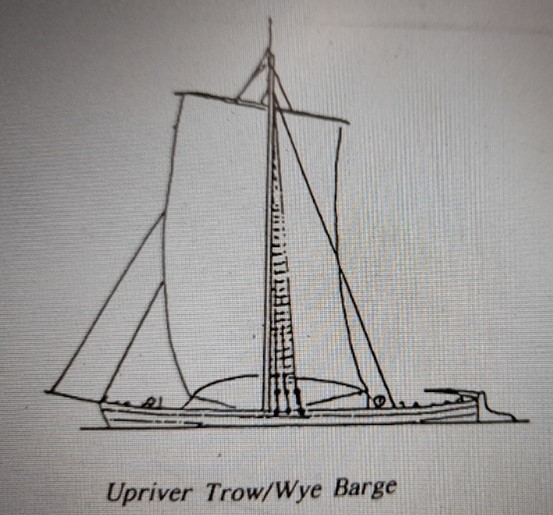
The Upriver Trow was around during the Tudor period, and had a flat bottom and a square sail.  Most were about 18m long and 4m wide and could carry 20-40 tons. Many became specialised and included the Wych Trow (sometimes known as Wich Barges) that carried salt from Droitwich. As they were low in the water and open, it is improbable that they would have been used in the open seas where the cargo of soluble salt was likely to have been washed away, but they have been recorded as voyaging to Bristol and other estuary ports which required the registering of the trows in the Ships’ Register, and these “open” hulled trows were banned from trading from a line west of Barry to Watchet. Other Upriver trows included the Wye and Stroud barges.

By 1850, Estuarine Trows appeared generally operating in the Severn Delta, and then the Sea-going trow came into use from 1900 with the last working until 1939. The Spry survives in Ironbridge Museum.

The Droitwich Salt industry depended not only on the export of common salt across the country and further afield, but also for the import of coal from Staffordshire and the Forest of Dean for the boiling of brine to make crystalline salt. The Salt carrying trows generally returned empty to preserve the purity of the salt, but in cases of “back” cargo it would be a “clean” commodity such as wheat.

Some of the trows 64 shares were jointly owned, but many were owned by one or two owners or by companies. In 1841, Edward Everton, Tailor is recorded as the sole owner of Hercules. Of the 195 identifications and owners recovered to date and recorded by Hingley (see below), 75 were called Harris, and 29 by the Everton family.  Companies listed were the Droitwich Salt Company, the Droitwich Patent Salt Company, Clay Newman and Co., and eventually the Droitwich Salt Union.  Sixty-four vessels with Droitwich connections from the 1902 Ships Register survives and are listed below.  Of these vessels, twenty are recorded as having been wrecked or sunk.

Illustration of John Putley – Severn Project - Gloucestershire County Council

The Severn Trows had hinged collapsible masts which were lowered when going under bridges along the River Severn. 

Wikipedia free encyclopaedia

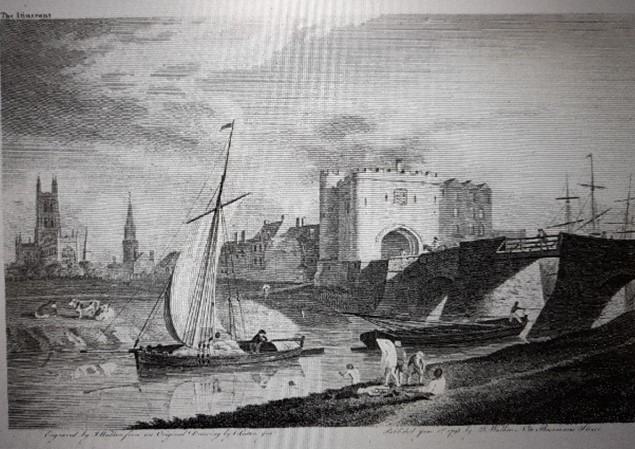
These sea-going trows were etched in 1798, one with a lowered sail going under a bridge at Gloucester, and the other with sail raised.

The 1833 Buckler sketch of the salt wharves at Droitwich shows an upstream trow in the foreground moored along the canal-side dock in the town below St Augustine’s church, and in the background on the canal a square-sailed upstream trow in sail. It is thought that the upstream trows probably remained square rigged until their disappearance.

British Library, Manuscript Collections (36393 p8) - The Nelly Copson Archive Collection

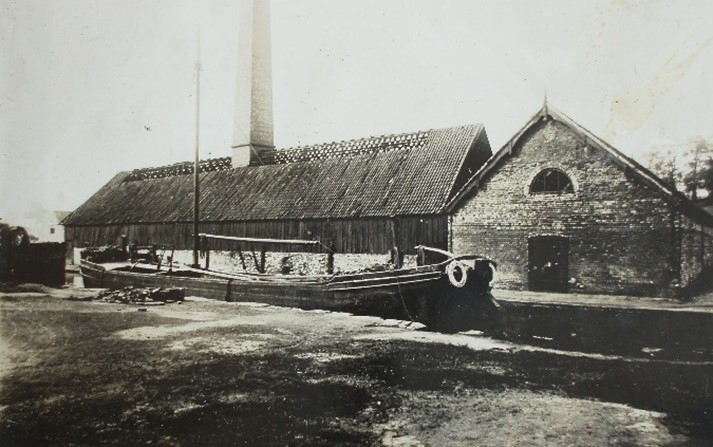
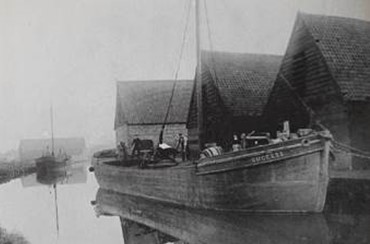
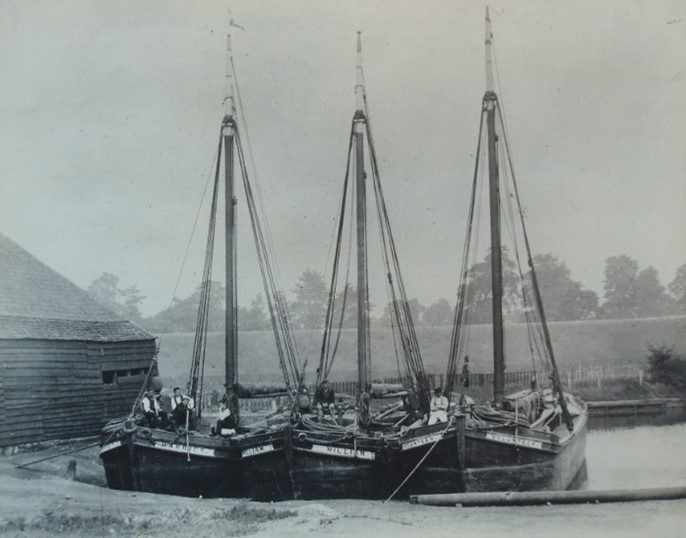
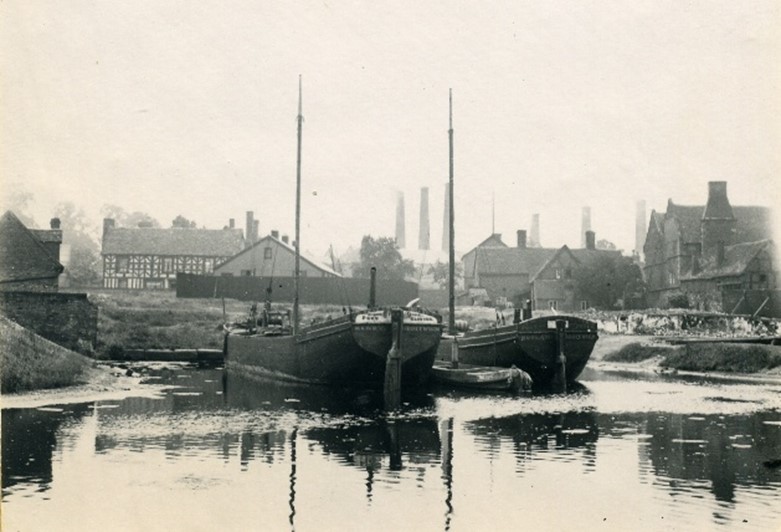
Severn Trows moored in Droitwich are pictured with sails down and safely stored, alongside the salt warehouses or at canal-side moorings.  One image shows Priory House in the background. 

The Success, built in 1826 weighing 30 tons - Image courtesy of Paul Jones LRPS

The Success, built in 1826 weighing 30 tons

The Henry at Rickett’s Lane - Image courtesy of Paul Jones LRPS

The Henry at Rickett’s Lane

Harriet, William built 1891, and Volunteer moored at Droitwich Basin 1904 - Image courtesy of Paul Jones LRPS

Harriet, William built 1891, and Volunteer moored at Droitwich Basin 1904

Priory House is in the background - Image courtesy of Paul Jones LRPS

Priory House is in the background.

One of the Wych Barges is recorded as carrying 90 tons of salt from Droitwich to France.

The canal was disused by 1918, as salt production was by then principally at Stoke Prior and generally carried by railways.

An article appeared in the 1957 ICI magazine recounting the last days of the last eleven working trows of the company’s fleet when disbanded in 1918. Recalling the words of George Harry Pittaway a mate to his father on the on the “Britianna” that in 1918 “even by modern standards life on these primitive craft was not so bad. A normal trip to Gloucester or Avonmouth and back would last seven or eight days. They took their food from home. With 65 tons of salt on board, a barge was horse-hauled to Hawford. In the river water another 35 tons would be taken on bard from a small canal boat. The men with a strap round their shoulders attached to a line would “bow-haul” their barge to Worcester. In winter, with the river in spate they would row their vessel down.  A tug took them from Worcester to Sharpness. Here they would hoist sail to Avonmouth. The trip from Droitwich to Bristol was made in three daily stages. At night they bunked down in the barge at Worcester, Gloucester and Avonmouth.

Last recorded bargemen with their nicknames when the fleet disbanded in 1918.


Britannia

George “Skipper” Pittaway

Mate: George Harry Pittaway

Morland

John “Morland Jack” Pittaway


Success

John “Cuckoo” Pittaway


Ripple

William “Dukes” Harris


Victory

William “Scraggy” Harris


Industry

William “Thummy” Harris


William

Joseph “Joe Tom” Harris


Harriet

Captain: Fred “Bargeman Fred” Harris


Harry

William Bourne “Dandy”


Hastings

William Bourne “Panto”


Volunteer

Skipper: George “Spring” Harrison


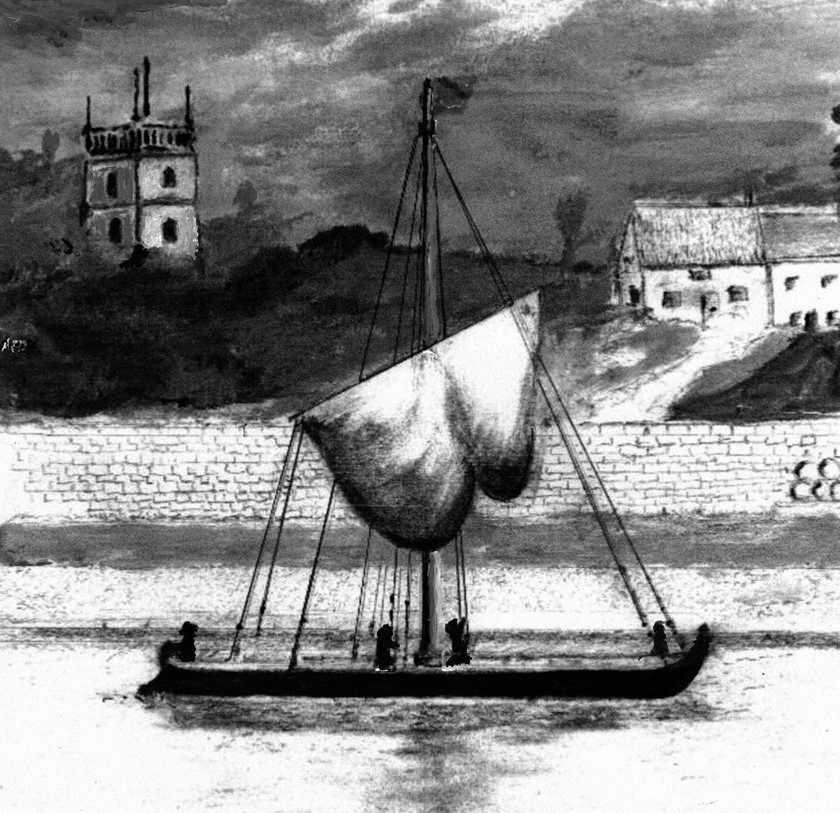
A trow illustrated at half-mast c.1880 - original drawing by Alan Davey 2025

A trow illustrated at half-mast c.1880  - original drawing by Alan Davey 2025.

List of Droitwich Owned Trows and Barges (dates converted/sold/lost not included below, but listed by Hingley).


Name

Date

Weight (in tons)

Owner

ALBION

1821

56

Harris

BETSEY

1839

28

Harrises

BLAINA

1834

55

Bought 1884 by Evertons

BRITANNIA

1839

25

Harris

BRITISH QUEEN

1839

25

Harris

CAROLINE

1834

25

Evertons

CAROLINE

1841

28

Evertons

COMMERCE

1828

57

Clay, Newman and Co, later Droitwich Patent Salt Co

CYRUS

1840

29

Evertons

DEFIANCE

1825

59

Everton then Droitwich Salt Co

HENRY

1829

60

Harris

HENRY

1862

29

Stourport “Gentleman” and Worcester “Gentleman”

HERCULES

1840

25

Evertons

HOPE

1802

45

Groves (inland use only)

INDUSTRY

1811

55

Graves

INDUSTRY

1818

24

Corbett

INDUSTRY

1883

36

Harris

INVINCIBLE

1826

22

Droitwich Salt Co

JUNO

1828

56

Caly, Newman and Co, then Droitwich Salt Co

MARTHA

1840

24

Droitwich Patent Salt Co

MARY

1812

56

Harris

MARY ANN

1827

24

Everton, later mortgaged to a Droitwich salt manufacturer

RICHARD

1835

26

Droitwich Patent Salt Co

RIPPLE

1895

41

Salt Union

ROSE

1868

33

Harrison

SAFETY

1839

30

Harris

SISTERS

1820

58

Owned in Pershore, then Harris of Droitwich

SPEEDWELL

1840

28

Harris

SUCCESS

1825

66

Harris

SUCCESS

1826

66

Droitwich Patent Salt Co

SUCCESS

1861

30

Harris

SURPRISE

1813

72

Harris

SURPRISE

1841

26

Harris

THOMAS

1837

23

Droitwich Salt Co

TWEED

1813

28

Gloucester, Bristol, Bath salt dealers, Bristol, Droitwich Salt Union

UNION

1837

21

Harris

UNION

1841

23

Gloucester, then Everton

VICTORY

1877

23

Harris

VOLUNTEER

1871

37

Harris

WESTCROFT

1863

33

Harris

WILLIAM

1819

59

Harris

WILLIAM

1891

29

Harrison

WONDER

1856

21

Coalbrookdale, then Harris of Droitwich


References

Droitwich Canals Trust 2011 – The Droitwich Canals

Blewitt, Lyn & Field, Bob 1994 – Droitwich A Pictorial History

ICI magazine 1957 page 3

Hingley, Peter 2000 - Some Droitwich Sailing Barges, Worcestershire Archaeological Society Transactions, pp235-51, 3rd series vol 17, 2000

Hughes, Pat and Leech, Annette 2011 – The Story of Worcester

Trinder, Barrie - Barges and Bargemen

www.canaljunction.com/heritage/craft/severn_trow.htm

www.snr.org.uk (The Society for Nautical Research)

https://www.gloucestershire.gov.uk/media/2ean3dyd/5-2a-the-severn-trow.pdf 

Wikipedia

Droitwich History & Archaeology Society June 2025.

John Heminges (1566-1630)

William Shakespeare’s First Folio was a collection of 36 works published in 1623, seven years after Shakespeare’s death. It was brought together by John Heminges and Henry Condell. Many of Shakespeare’s plays had not previously been published, and so it is likely that without the First Folio, these plays would have been lost to us today.

John Heminges was baptised at St Peter-de-Witton Church in Droitwich on 25 November 1566. He was sent to London at the age of 12 to be an apprentice grocer and became a freeman of the Grocer’s Company on 24 April 1587.

He was a friend of Shakespeare, and a co-founder of the Lord Chamberlain’s Men (the playing company for which Shakespeare wrote during most of his career, which later became the King’s Men) and the Globe Theatre. Some sources credit Heminges with originating the role of Falstaff, a primarily comic figure appearing in three of Shakespeare’s plays.

Although credited as an actor, sources indicate that Heminges made a greater contribution to the business side of the playing company, utilising his status as a Grocer to support the playing company financially and promote connections at the highest possible social level. Records indicate that the Lord Chamberlain’s Men performed around 320 times in the courts of three monarchs during Heminges’ lifetime: Queen Elizabeth I, King James I and King Charles I.

References: